Hack #2
Tradlife: The Game of Reality
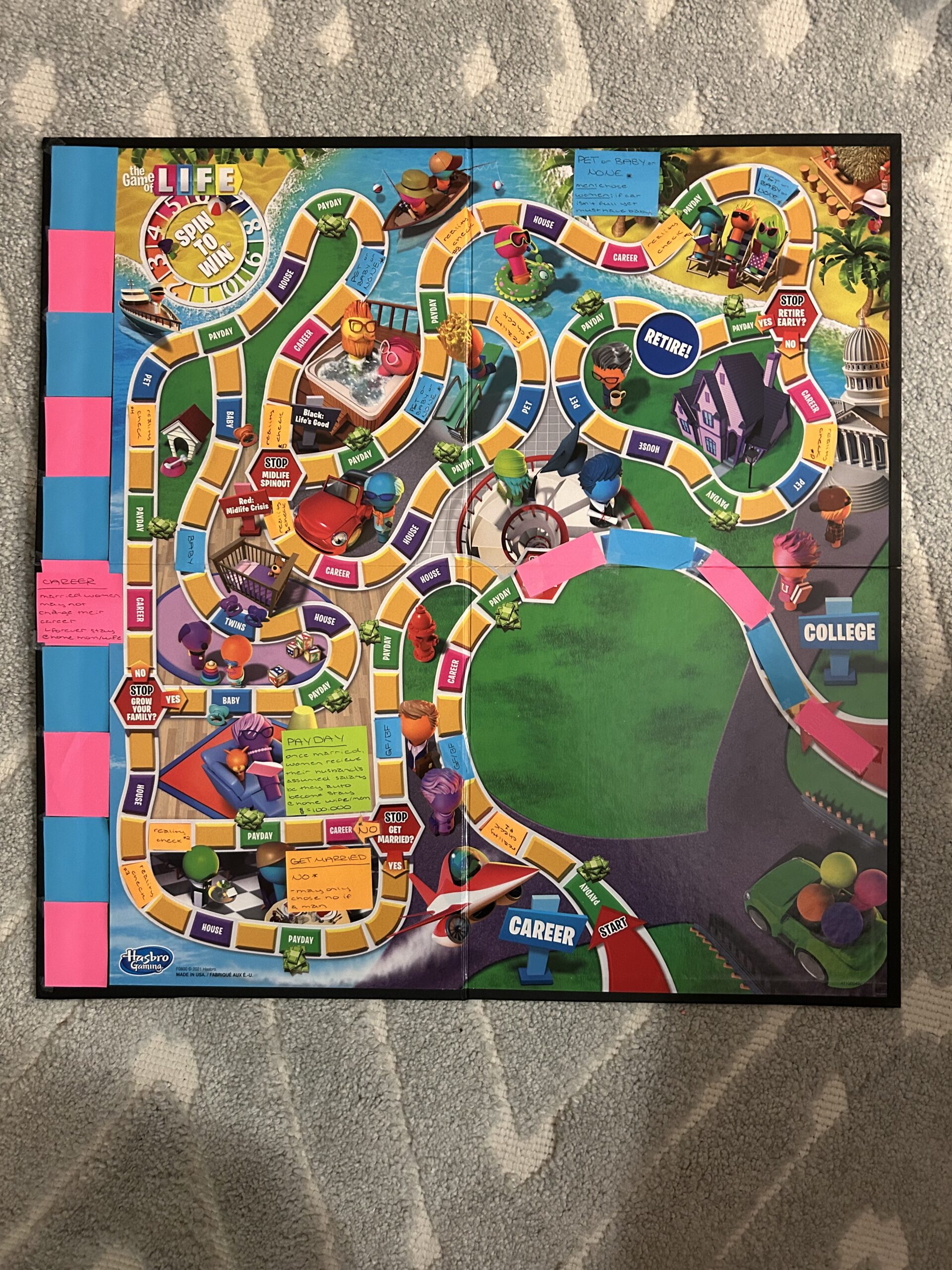
For my second Hack of this class, I decided to add a bit of a twist to The Game of Life. This idea first came to me when we were exploring adversarial design, as presented by Carl DiSalvo in his Adversarial Design. The notion of creating designs that are intended to provoke critique, discussion, and even disruption really spoke to me. On February 4th, the class discussed different ways the game Cops and Robbers could be reskinned in order to make a broader, more important critique or play on a serious matter. In the middle of this discussion, my brain somehow landed on reskinning The Game of Life. Although I was unsure of how I wanted to comment or critique, I knew I wanted to make an important assertion about the disparities in expectations for men and women in the trajectory of their lives. This ties right into Mary Flanagan’s definition of critical play, which she explains to be a “careful examination of social, cultural, political, or even personal themes that function as alternates to popular play spaces” (6).
I sat down with the game and began brainstorming. The creators of the board game have updated it since I last played, making it more inclusive to nontraditional lifestyles, which is great; however, I believe it does not accurately reflect the pressures and beliefs in society. The game has become more progressive, yet it does not actively consider the slow-changing nature of real life. In order to accurately portray the way that society still views adulthood, marriage, familial relationships, and the workplace, I needed to reskin the game.
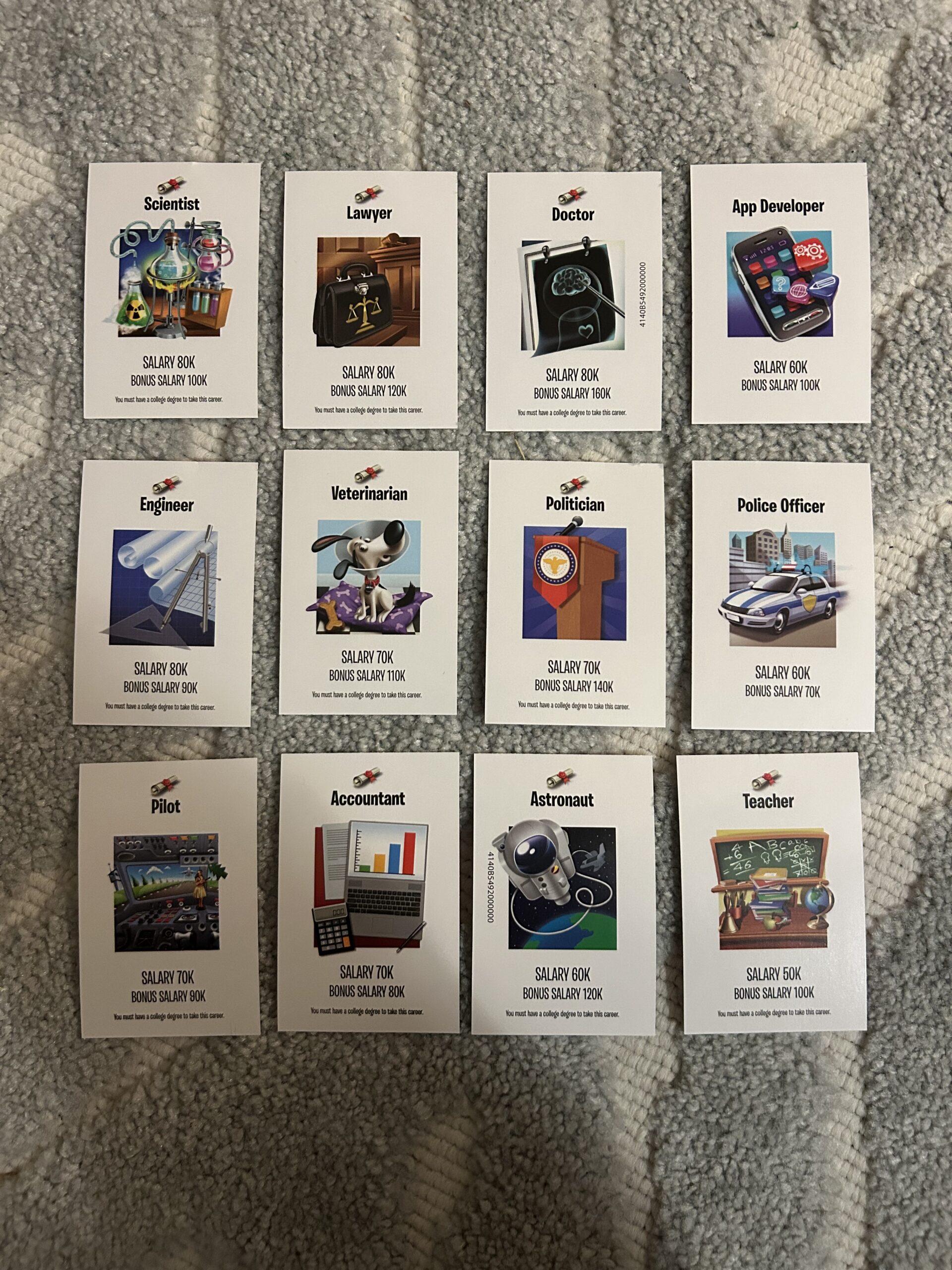
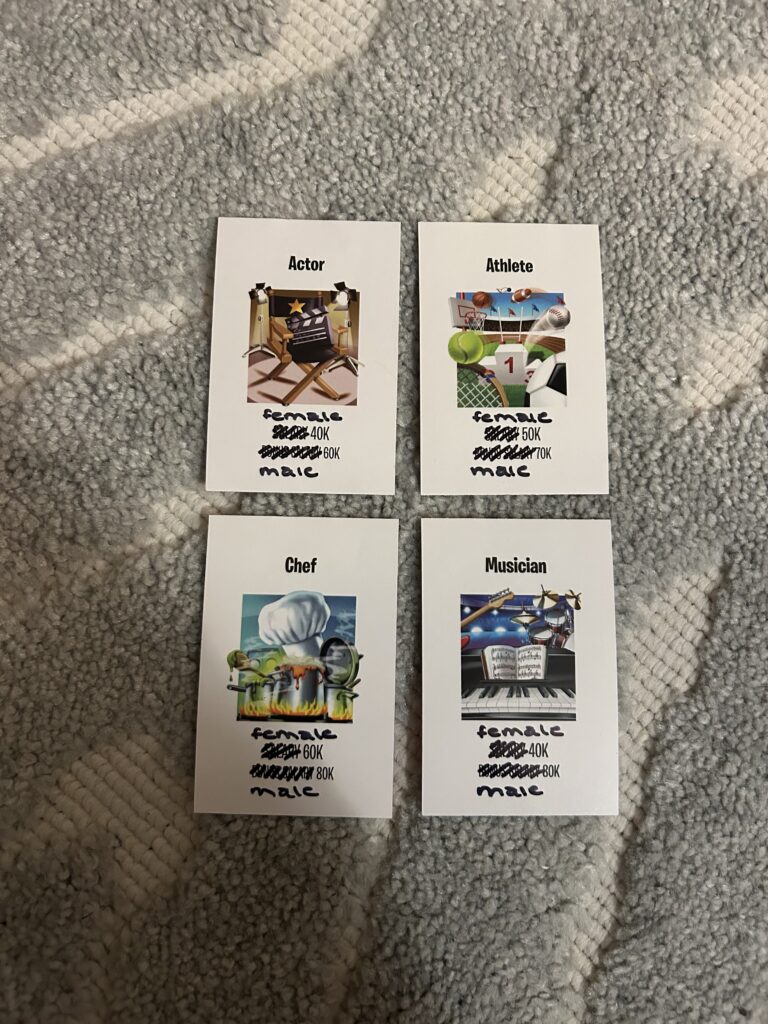
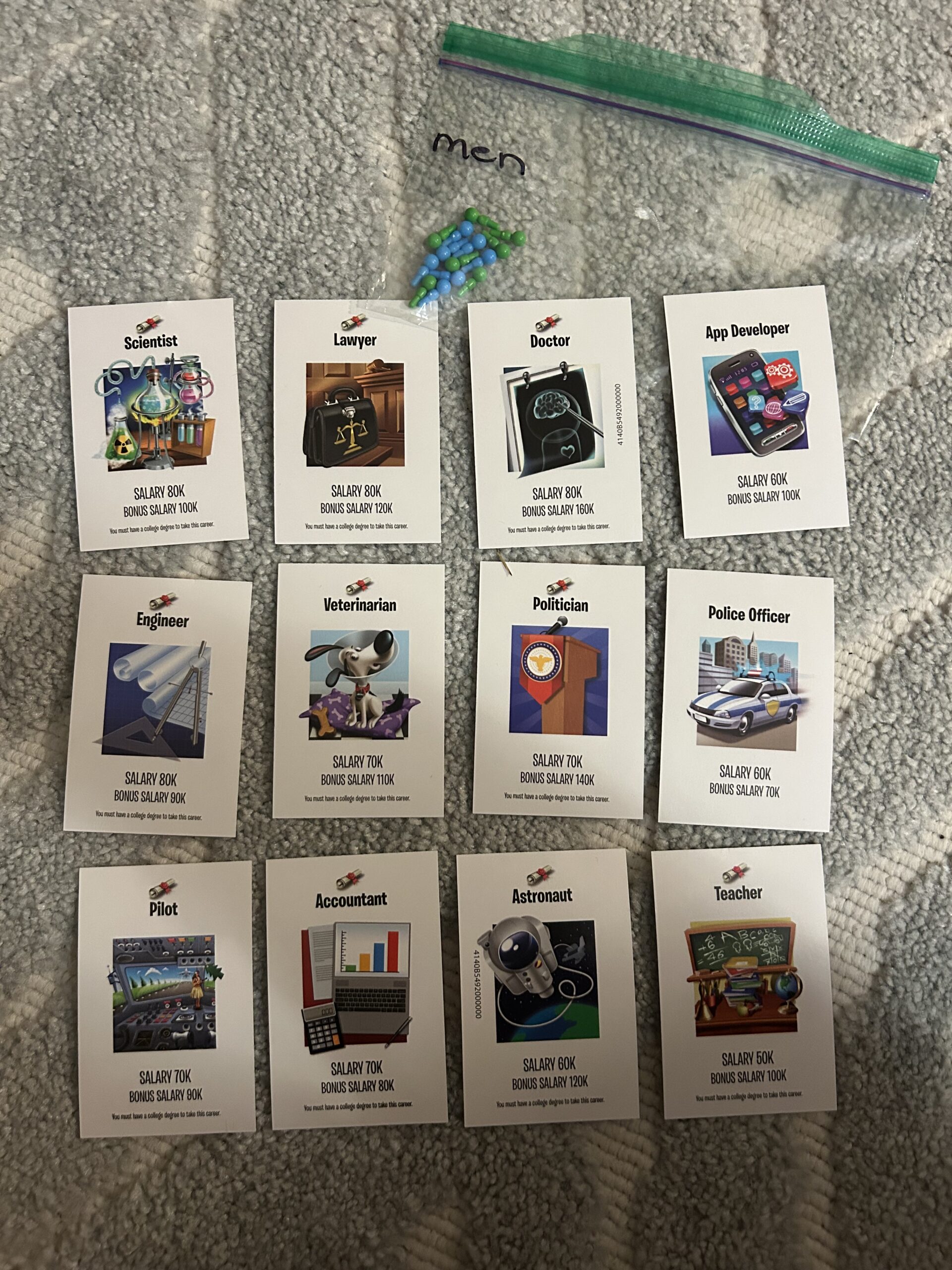
To begin, with the very first step of the game, I wanted to expose one of the biggest and most important barriers that remain between males and females – the pay gap. The player randomly chooses one occupation from their gendered stack and one occupation from the either gendered stack. They then get to decide which occupation they want to have. The male “gendered” occupations all require graduation from high school and hold the prestige of “high-paying jobs” (pictured below). On the other end of the spectrum, females are allowed to pick from low-level jobs that require no education. Lastly, the either gendered stack includes four jobs; however, the pay gap is reflected in the job’s respective salaries. This reflects a harsh but true reality: Not only are women typically kept out of work in areas such as science and math, but they typically receive less pay than men for the same job when they are equally qualified.
After starting the game, the players who chose to be female are hit yet again with another obstacle. Only men have the option to not get married. Although this is not completely realistic, it accurately reflects the general sentiments society poses about marriage. If a woman in her forties is not married, it is viewed as weird and frowned upon. However, if a male counterpart is similarly single, there is no comment or second thought. Additionally, the game explains that once married, the women must quit their jobs to become stay-at-home wives. This is another typical assumption of women. Although women today are doing a great job at breaking this stereotype, it is still considered traditional for women to be caretakers and stay at home. I also made the rule that women then receive the average amount of salary that their theoretical husband would be making ($100,000). This is more than any possible job a female player could make in the game (based on how I designed it). I did this to show that no matter how much a woman does, they often receive and are viewed as less than men. These female players are now just as profitable as a man because they receive their salary; however, they do not have the freedom of decision, which they will soon find out.
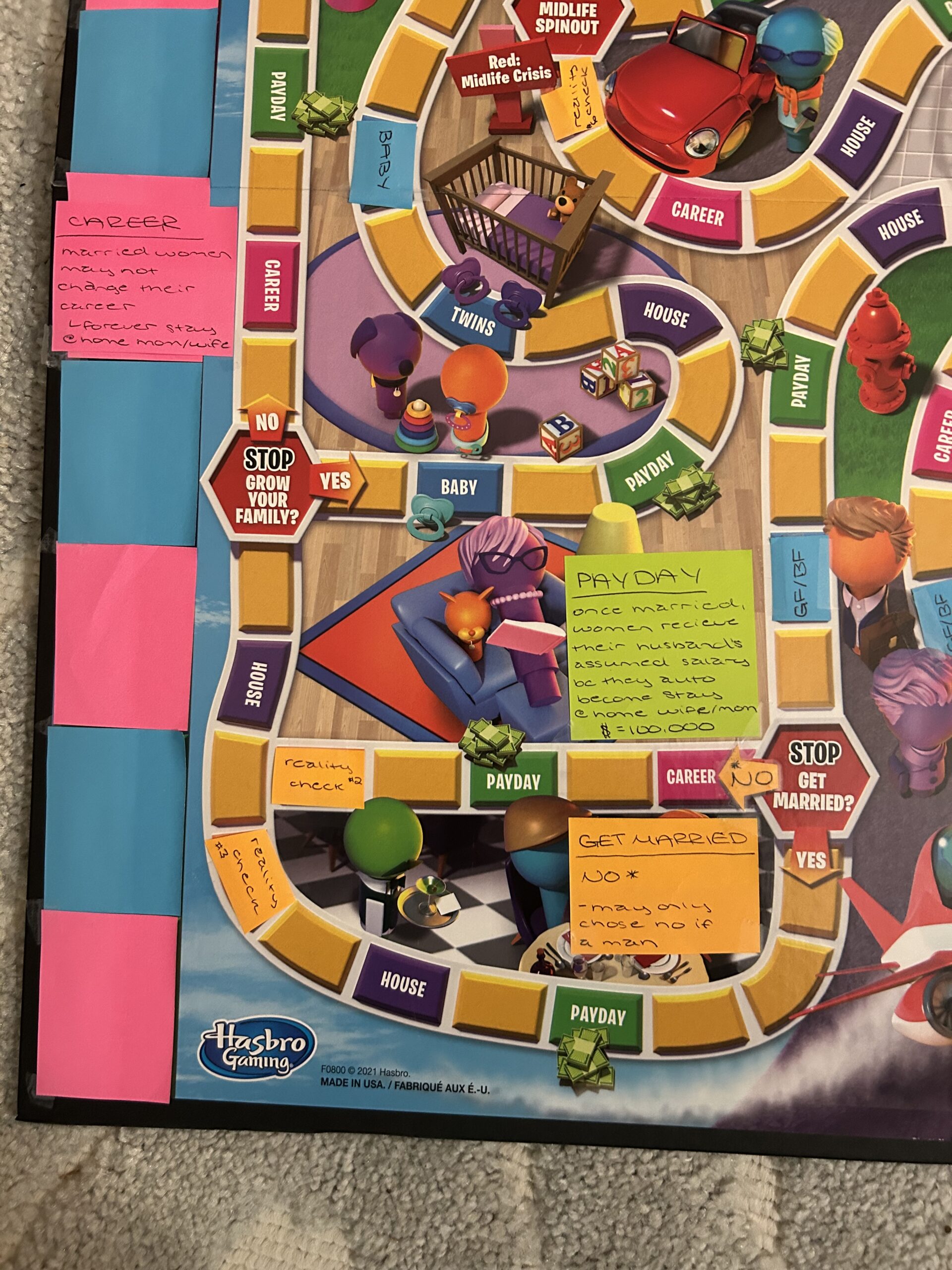
As the game progresses, the female players encounter their next hurdle. If they land on a “baby, pet, or none” space and their car is not full – representing that their family is not complete based on societal standards – they must have another baby and have no option. On the other hand, the male players have free will to choose any of the three they please. As I alluded to above, the female players wish they would have just chosen to be male from the beginning because they would have been more successful and had more autonomy over their lives. Additionally, I thought requiring the women to have a baby provided a cheeky commentary on women and unwanted pregnancies. If a man were to accidentally get a woman regent, he could just disappear and never suffer any consequences. However, women do not have that option. The responsibility falls completely on them, and they can not simply “get rid of it” (I am not going to get into politics here, but they have to deal with their decision either way). Society pressures women to have babies and continue producing offspring no matter their story or what they actually want. It is by a man’s doing that a woman gets pregnant, yet a woman has to deal with everything and suffer any consequences that come as a result.
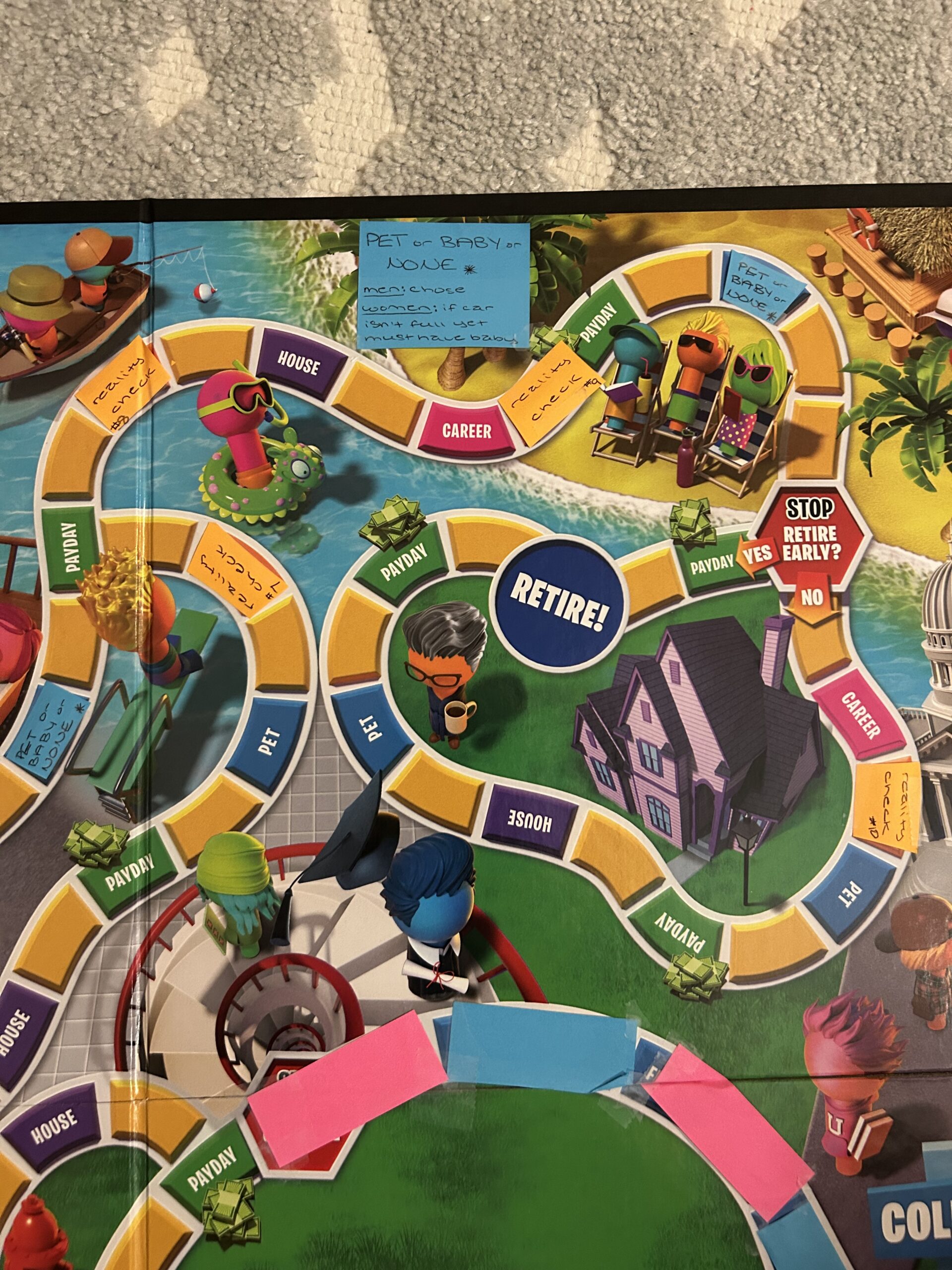
The last modification I made to the game was to change the “investment” squares into “reality check” spaces. Ten of them are shown below. These cards correspond to the stage of life the players are in during the game. They serve as commentary on the assumed standard of women and the role of moms. Most of these have two “checks,” one for male players and one for female players, with the female players being disparately impacted by having to skip a turn or lose a significantly greater number of women.
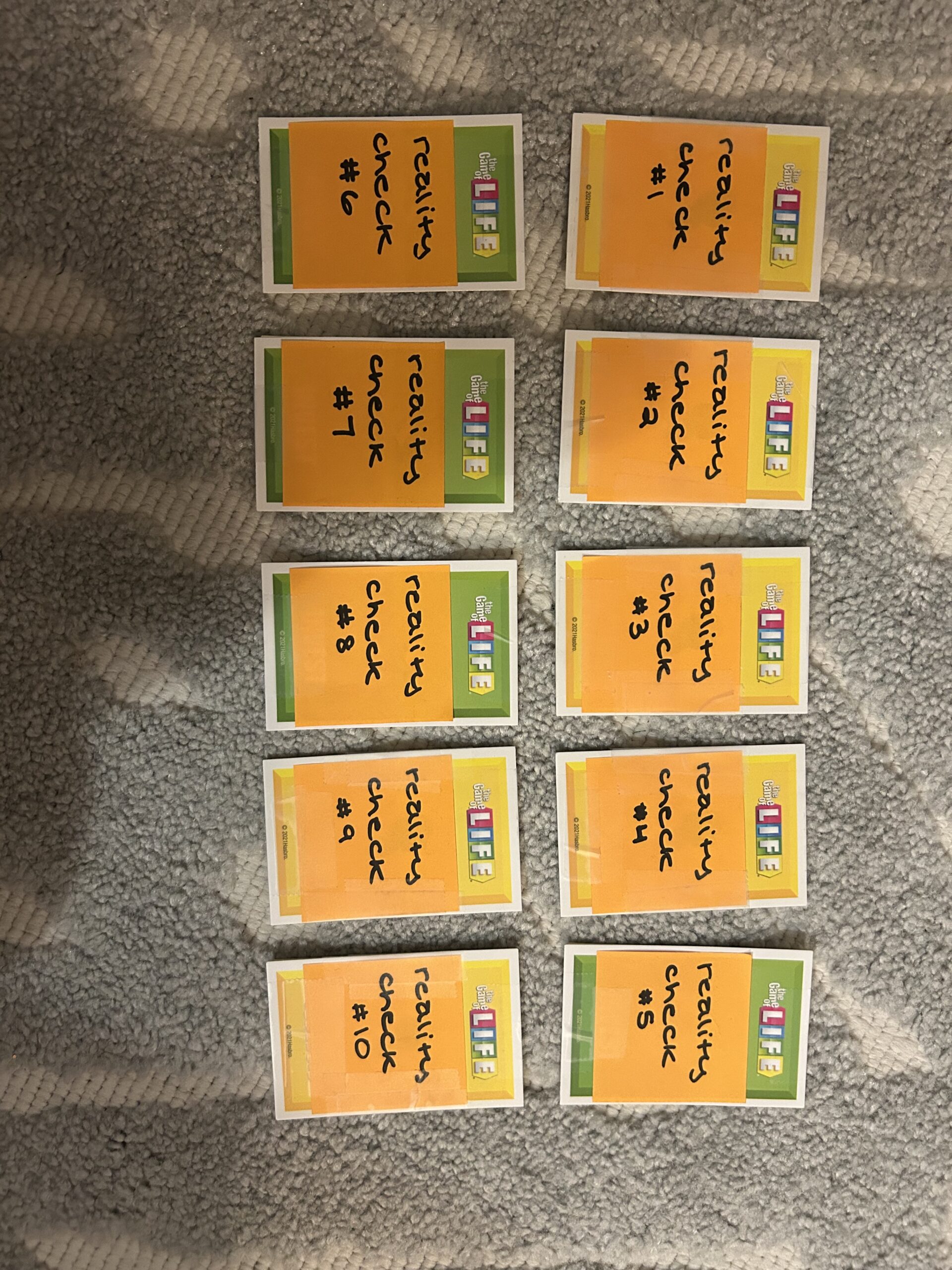
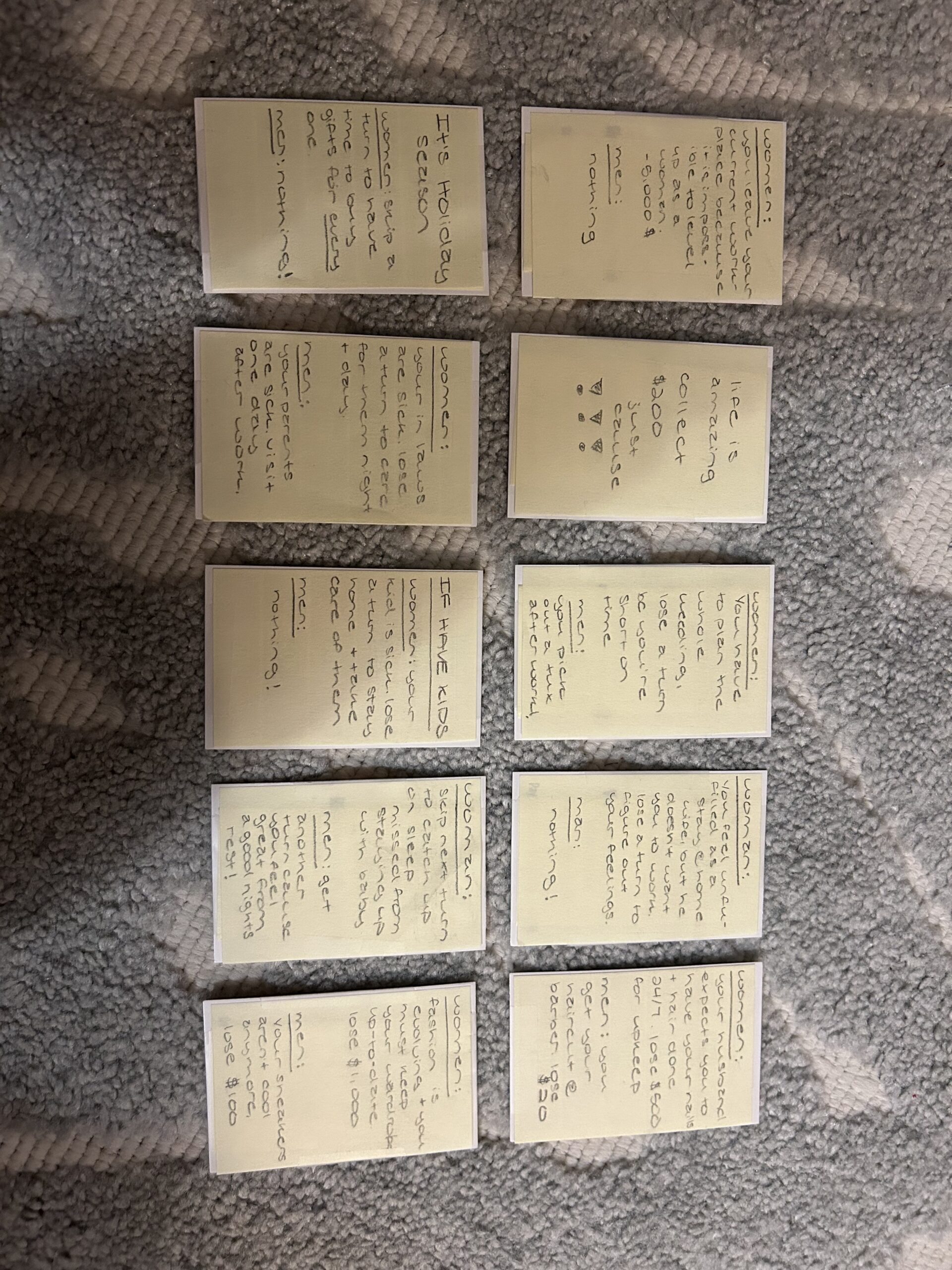
I chose not to make these stipulations apparent until the users started the game in order to confront them with reality head-on like a person experiences in the real world. Women do not get a “trigger warning” that allows them to avoid these obstacles and unfair standards that society poses. My game took a confrontational or intervention approach to critical play (Flanagan 11). Through my creation, I hoped to take a fun game of endless possibilities and put it into the realm of real life: Life is not actually a game of endless possibilities. The constraints, standards, and disadvantages that society yields to women do not allow for the same upward mobility and magical life that men can experience with ease. This game forces the aspect of critical play as it confronts users and requires them to think about actual life trajectories.
Works Cited:
Carl DiSalvo, “Design and Agonism” from Adversarial Design (2012), pages 1-26
Mary Flanagan, Critical Play: Radical Game Design (2009)

